
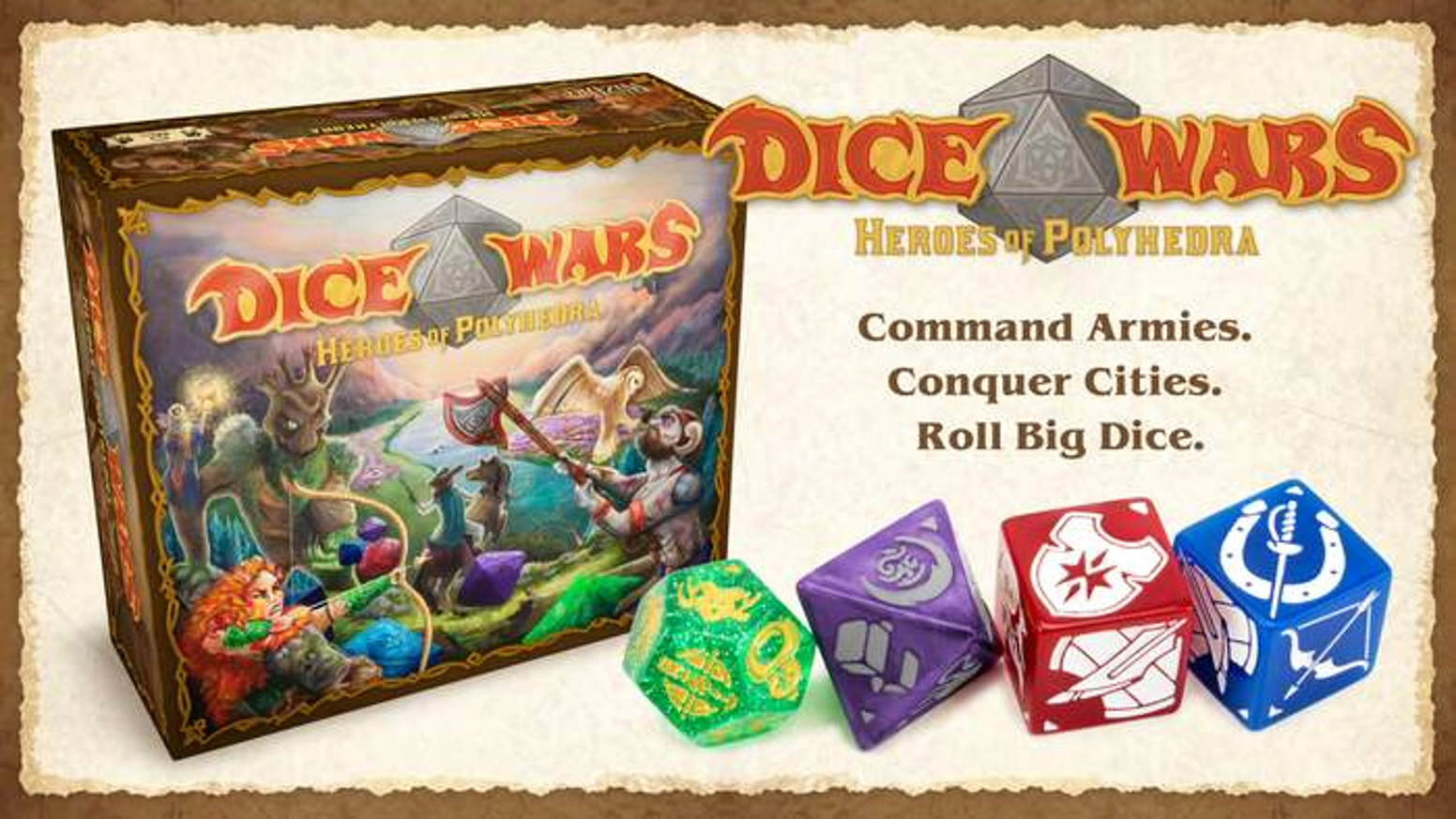
If you’ve ever played Dice Wars, you already know how unbelievably addictive this strategic little game can be. What starts as a simple board filled with pastel-colored territories quickly turns into an intense chess-like battle where every decision—every roll—can reshape the entire map. And while luck does play a role, Dice Wars is not the pure game of chance it appears to be. Beneath the surface, there’s a deeper strategy that separates casual players from consistent winners. In this guide, we’ll break down expert-approved approaches that can help you dominate almost every match you play
Understanding the Core Mechanics of Dice Wars
Before you even think about advanced strategies, you have to understand the logic behind Dice Wars. At first glance, it seems like everything depends on the roll. After all, more dice usually means greater odds. However, the real game lies in recognizing how territory distribution, reinforcement phases, and attack decisions impact your long-term control.
The first thing to realize is that Dice Wars rewards patience. Many new players rush into attacks simply because they have more dice on a territory than their opponent. But seasoned players know that every attack costs you dice—even successful ones. This constant drain can weaken your position if you’re not choosing battles wisely. The game, at its core, is about maximizing value while minimizing loss.
Another thing players often overlook is how the board reshapes after every round. Holding more connected territories grants you more reinforcements during the redistribution phase. That means a larger army the next turn. Even if your rolls are mediocre, controlling wide clusters ensures steady recovery. Winning isn’t just about beating enemies—it’s about growing your resource base faster than they can rebuild theirs.
And finally, randomness isn’t your enemy if you understand probability. Dice Wars follows a predictable pattern: the more dice you hold, the higher your chances of winning. But that doesn’t mean guaranteed success. So instead of expecting perfect rolls, play with probability, not hope. When you shift from emotional attacks to calculated risk assessment, the entire game changes.
Mastering the Art of Positioning
One of the biggest mistakes beginners make is ignoring positioning. It’s tempting to focus only on the raw number of dice on a territory, but where that territory sits on the board often matters more than how many dice it holds. A territory on the edge of the map is safer than one in the middle, because it has fewer enemy borders. Fewer borders mean fewer incoming threats, making them ideal “banks” for storing high-dice stacks.
Strong players start by identifying choke points—locations that control movement between large regions. These act like gates on the board. If you hold a choke point with a big stack, you can effectively seal off your area from enemy invasion. This keeps your reinforcements safe and concentrated where they matter. Think of it like building walls in a strategy game.
Another aspect of positioning is avoiding overextension. Expanding too quickly might feel powerful, but it often leaves you vulnerable. Every territory you capture increases your borders and divides your dice among more areas, weakening your overall defense. Top Dice Wars players expand only when it strengthens their position. Instead of grabbing everything they can, they shape the board so that they control compact clusters.
Lastly, consider symmetry on the map. Sometimes, two players share a similar number of territories, but their positions differ. The player with a compact, connected cluster has a huge advantage over someone stretched thin across multiple sections. The better your positioning, the easier it becomes to snowball into late-game dominance.
Smart Attacking: When to Strike and When to Hold
Aggressive players often lose because they attack too frequently. It’s exciting to knock out an opponent’s territory with a large dice stack, but every attack reduces your stack and introduces uncertainty. Instead, smart players follow one golden rule: only attack when the gain outweighs the risk.
Before launching any attack, ask yourself: Will this improve my long-term strength? If the answer is no, skip it. It’s far better to hold your ground, keep your dice, and collect reinforcements next round than to waste them on a flashy move that doesn’t shift the balance of power.
Another crucial factor is chain attacks. One well-timed attack can open doors to multiple follow-up attacks that snowball into huge territorial gains. But these chains only work if you have enough dice behind them. That’s why pros typically wait until they have territories with 7 or 8 dice before going on offense. These stacks act like bulldozers—they break through enemy lines quickly and efficiently.
Holding is also a form of attack. Sometimes, by not attacking, you force opponents to target each other instead of you. When you look weak, the board shifts aggression away from your cluster. And when the time is right, you can emerge with a well-timed strike to sweep weakened areas. Dice Wars is a psychological game, and restraint is often more powerful than brute force.
How to Build and Maintain Strong Dice Stacks
High dice stacks—those 7 or 8 dice territories—are your main weapons. They act as both a shield and a sword. But building them the right way takes discipline. Many players spread reinforcements across their map, leaving several medium-sized territories instead of a few powerful anchors. This weakens your ability to attack and defend effectively.
Instead, you want to funnel reinforcements into one or two critical territories. These become your “power centers.” From these centers, you can expand outward in future turns. But it’s not enough to create these stacks—you must protect them. Always position them deeper in your territory, not on the front lines. That way, enemies can’t wipe them out easily.
Another important trick is to let some territories sit at low dice counts early on. While it may feel risky, this allows you to pump extra reinforcements into your main stacks over multiple turns. Once your core is strong enough, you can quickly refill weaker areas by expanding outward.
And remember: high stacks are not invincible. Play smart. Because Dice Wars reinforcements depend on connected territories, losing a chain in your cluster can reduce your dice gain dramatically. Protect your links at all costs. One broken connection can set you back several turns.
Reading the Board Like a Pro
One of the most underrated skills in Dice Wars is reading the board. Most players focus only on their own defenses and attacks, forgetting that predicting opponents’ moves is just as important. You must constantly observe patterns: Who is expanding aggressively? Who has weak borders? Who is about to run out of steam?
A player with multiple 1-dice territories is a prime target. Not because you want more land, but because each easy capture strengthens your cluster and increases reinforcement bonuses. By contrast, attacking a player with only high-dice regions rarely pays off early on.
Another aspect of board reading is recognizing stalemates. Sometimes, two strong players will face each other across choke points. In this situation, patience wins. Let them drain each other while you consolidate power in safer zones. When they finally clash, you’ll have the strongest position.
Board reading also means watching the reinforcements. If an opponent is gaining many dice each turn, they likely have a big cluster somewhere. Before attacking, identify that cluster and disrupt its shape. Even capturing one connecting territory can drastically reduce their reinforcements, making their entire structure collapse.
Long-Term Strategy and Late-Game Control
The late game of Dice Wars is where champions are made. By this stage, most weak players have been eliminated, and the remaining ones usually have strong stacks and strategic placements. To win, you must transition from slow, calculated expansion to decisive, rapid attacks.
In late-game play, timing is everything. Attacking too early drains your dice and leaves you vulnerable. Attacking too late gives your opponent enough space to reinforce. The perfect moment is when your largest stack is full, your borders are stable, and an opponent has multiple low-dice regions exposed.
In this phase, chain attacks become essential. You should look for paths where you can capture 4–6 territories in a single turn without thinning your army too much. Each territory captured strengthens your future reinforcement gains, so these late-game sweeps often decide the outcome of the match.
Don’t underestimate the value of clearing an entire color from the board. Once a player is eliminated, their remaining territories are no longer a threat, and you can spread your reinforcements freely. Removing one opponent often triggers a momentum shift that makes it nearly impossible for remaining enemies to catch up.
And finally, maintain balance. Even in late-game dominance, don’t leave thin borders behind your expansion path. A single flank attack can ruin everything. Winning requires both offense and steady defensive coverage.
Expert-Level Tricks Most Players Don’t Know
Some advanced tactics don’t become obvious until you’ve played dozens of matches. Here are a few secret techniques that top Dice Wars players use regularly:
1. “Dice Starving” OpponentsThis involves focusing on cutting an opponent’s connections rather than attacking their strongholds. When they lose connectivity, they lose reinforcements—even if they still hold many territories.
2. Controlled Sacrifice Sometimes intentionally leaving a territory weak forces opponents to attack it instead of your main stack. This distracts them and wastes their dice.
3. Ending Your Turn on High DiceAlways finish your turn with your biggest stack untouched if possible. The game rewards strong defensive positions more than reckless conquest.
4. Deliberate Non-ExpansionSome turns, the smartest move is to not expand at all. If expansion exposes your cluster, the risk isn’t worth the extra territory.
5. Territory LoopingCreate loops or circles of connected territories so losing one doesn’t break your entire chain. This keeps reinforcements stable even under pressure.
These tricks aren’t about luck—they’re about playing smarter than your opponents.
Final Thoughts: Becoming a True Dice Wars Master
Winning consistently in Dice Wars requires patience, calculation, and awareness. While luck will always play a small role, skill ultimately determines who controls the board. When you learn how to position correctly, build powerful stacks, choose your attacks carefully, and control late-game momentum, you’ll start winning far more often.
