
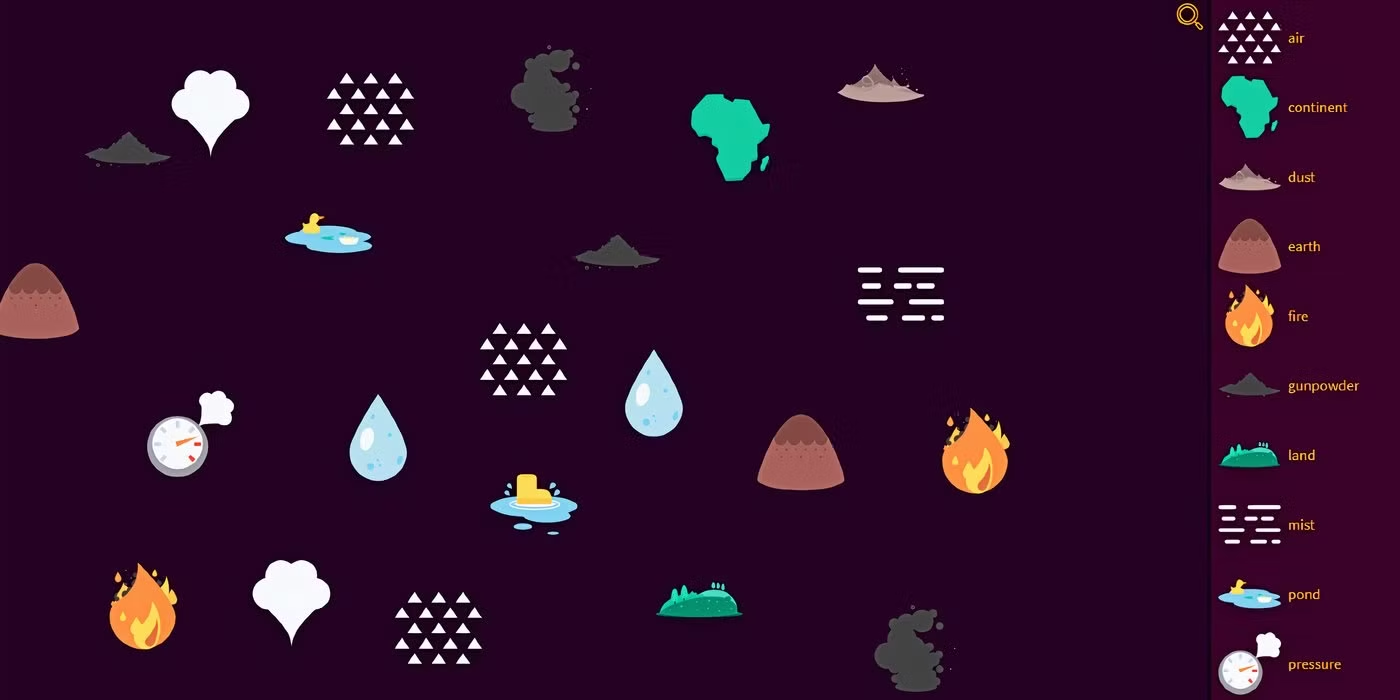
If you’ve ever opened Little Alchemy 2 and suddenly found yourself three hours deep combining Air with Fire like some chaotic digital chemist, you’re not alone. This simple-looking puzzle game has an irresistible charm. It starts with just four basic elements but somehow spirals into hundreds of wild combinations, unexpected results, and endless curiosity. Whether you’re a beginner trying to craft your first tool or a seasoned player chasing the final elusive element, this guide walks you through everything you need to know. Think of it as your complete Little Alchemy 2 handbook—from your first sparks of creation to the most complex, mind-bending formulas.
Understanding the Core of Little Alchemy 2
Before you dive into endless mixing and matching, it helps to understand what Little Alchemy 2 actually wants from you. Sure, it’s a game about combining items, but beneath that simplicity is an intuitive system designed to encourage creativity, experimentation, and even a little storytelling. Every combination reflects real-world logic—well, most of the time—and that’s part of what hooks players for hours.
The game gives you four basic elements: Air, Earth, Water, and Fire. These aren’t just your starting ingredients; they’re the foundation of absolutely everything you’ll create. From Stone to Life to entire universes, it all begins with these four. Learning how the game interprets these basics helps you predict new combinations without checking recipes every five minutes, and that’s when the real fun begins.
Another important part of Little Alchemy 2 is the element hierarchy. Some results act as building blocks for bigger ideas. For example, Stone leads to Metal, which leads to Electricity, which eventually helps unlock modern concepts like Computer or Robot. Once you see how items evolve, you start building mental chains. It won’t take long before you’re combining elements instinctively and feeling like an alchemist in your own right.
Finally, the game is structured around discovery. Every time you unlock a new item, you get that spark of satisfaction. It’s addictive. And because there are over 700 items to create, there’s always something new waiting for you. This sense of gradual progress keeps you motivated, even when certain combinations feel impossibly elusive.
Mastering the Basics: Essential Early Combinations
The first hour or two of gameplay is all about building up your library of fundamental elements. These are not flashy, but they’re the backbone of more advanced creations. Without learning and mastering the basic combinations, you’ll hit a wall later. Think of these early discoveries as your toolkit for future alchemy success.
One of the earliest breakthroughs is unlocking Stone. Combine Earth + Fire and suddenly everything feels more possible. Stone can transform into tools, structures, and even early metals. From there, you can branch out into crafting Metals, Lava, Minerals, and other essentials. Each of these opens up dozens of new potential paths.
Another big moment happens when you discover Life. It unlocks the biological branch of the game—everything from humans to animals to plants. The most common recipe is Energy + Puddle/Primordial Soup, but even reaching Energy requires several earlier steps. That’s where many new players stumble, but once you understand the pattern—create a rough version of real-world processes—the puzzle becomes easier to decode.
And of course, you can’t forget Tool. Creating Tool starts you on the technological branch. With Tool in your arsenal, suddenly you can build structures, machines, weapons, and even professions. Tool often pairs with natural elements to make something manmade, so it becomes one of your most versatile items. Once you have Tool, stick it on almost everything you’ve unlocked—you’ll be shocked how much new stuff appears.
These basic foundations give you the confidence to experiment. Instead of randomly dragging items together, you begin thinking logically. You’ll start noticing patterns, like how combining something natural with something human-made usually creates a new invention. The game rewards this kind of thinking, so leaning into it helps you progress faster.
Unlocking the Big Concepts: Life, Humans, and Civilization
As your element list grows, you’ll eventually begin building more advanced and abstract ideas. This is where Little Alchemy 2 becomes extremely fun because you’re no longer crafting simple objects—you’re creating entire civilizations, environments, and philosophies.
The first major milestone is Life, but the real turning point comes with Human. Once you unlock Human, new possibilities explode. Humans can be paired with nearly everything: environments, objects, animals, tools, and even abstract elements. With Human, you suddenly gain access to professions such as Farmer, Firefighter, Doctor, Miner, and Sailor. Each of these leads to new items and categories.
With Humans comes Civilization, another huge step. Creating Civilization often requires mixing Humans with advanced structures or tools. Once you have it, you can generate everything from Politics to Philosophy. These abstract items might not feel as exciting as making a Dragon or a Spaceship, but they help you progress toward some of the highest-level creations in the game.
The biological path also expands once you create Life. Animals, plants, environments, and natural processes start appearing. You can build forests, oceans, deserts, and even entire ecosystems. This makes the world feel larger and more interconnected. Combining Life with different natural structures helps you discover variations like Birds, Mammals, Insects, and Reptiles.
As your mastery grows, the game becomes less about guessing and more about understanding. You’ll begin predicting how to craft new environments or creatures based on real-world logic. The more you unlock, the more you appreciate how elegantly the game mirrors reality, even with its whimsical charm.
Exploring Advanced Crafting: Technology, Mythology, and Beyond
Once you’ve mastered the basics and built your society, Little Alchemy 2 opens an entirely new world of advanced elements. These include high-tech inventions, mythical creatures, legendary symbols, and conceptual items that stretch your imagination. This is where the game becomes extremely rewarding for players who love deep exploration.
The technology branch is one of the most complex, and it begins with electricity-related creations. Once you craft Electricity, you can move on to Computer, Robot, Machine, and dozens of futuristic inventions. These items often require multiple steps—sometimes five or six building blocks chained together—but that’s exactly what makes them satisfying. Every big breakthrough feels earned.
Another fan-favorite area is mythology. When you pair Humans with imagination or story-related items, suddenly you begin crafting creatures like Dragons, Phoenixes, and Deities. This part of the game taps into folklore and legends, making the combinations more creative and unpredictable. Even better, many mythical items branch out into their own lines, allowing you to create magic, spells, ghosts, and entire supernatural worlds.
The game also includes advanced nature-based elements. Once you unlock big environmental concepts like Universe, Galaxy, Planet, or Atmosphere, you enter a cosmic level of crafting. These combinations feel huge and symbolic, turning what started as a simple puzzle game into a journey through the building blocks of existence.
By the time you’re exploring these high-level items, you’ve already developed a solid intuitive understanding of how Little Alchemy 2 works. You’ll find yourself thinking like a real alchemist, combining ideas instead of objects. And that’s when the game feels truly magical.
Expert Tips and Strategies for Efficient Progress
Every Little Alchemy 2 player hits a point where they feel stuck. You’ve discovered hundreds of items, but suddenly nothing new is appearing. This is normal, but with a few expert strategies, you can push through those plateaus and keep progressing smoothly.
The first strategy is to work in categories. Instead of mixing items randomly, focus on one branch—animals, tools, planets, magic, etc.—and tackle combinations systematically. This helps you avoid wasting time and gives you clearer goals.
Next, don’t ignore the basics. The four foundational elements—Air, Earth, Fire, Water—play a role throughout the entire game, even in later stages. Sometimes the simplest combinations yield the biggest breakthroughs. When you’re stuck, always circle back to these early ingredients and test them against newer items.
Another helpful tip is to think in real-world logic. If you want to create a tool, think about what would exist in reality. For example, to make a sword, you need Metal and something that represents craftsmanship. This approach works far more often than guessing.
Also, keep an eye out for abstract items. Concepts like Time, Philosophy, or Story might seem strange, but they unlock dozens of advanced combinations. These often feel like “key” items that open new stages of the game once you obtain them.
Lastly, experiment at your own pace. The joy of Little Alchemy 2 isn’t in rushing to finish the list—it’s in the discovery process. Every unexpected combination feels rewarding, and every breakthrough reminds you why the game is so addictive.
Conclusion
Little Alchemy 2 is one of those rare puzzle games that manages to feel simple and limitless at the same time. With just a handful of starting elements, it encourages you to think like a creator, an inventor, and a curious explorer. From basic items like Stone and Life to advanced creations like galaxies, mythical beings, and futuristic technology, the game unfolds in layers that keep you hooked for hours.
